
Welcome to another election year! In November, Tennesseans will join voters across the country in casting ballots for congressional representation in this midterm election cycle. At the state level, we will also elect a new governor and choose our state representatives – the whole state House and the odd-numbered state Senate districts.
But before then, in elections that often get overshadowed by the state and federal races that draw more attention, Tennesseans will also elect multiple county representatives. County offices (e.g., county mayors, commissioners, and sheriffs) and judicial offices (e.g., judges and clerks) will be on the ballot around the state.
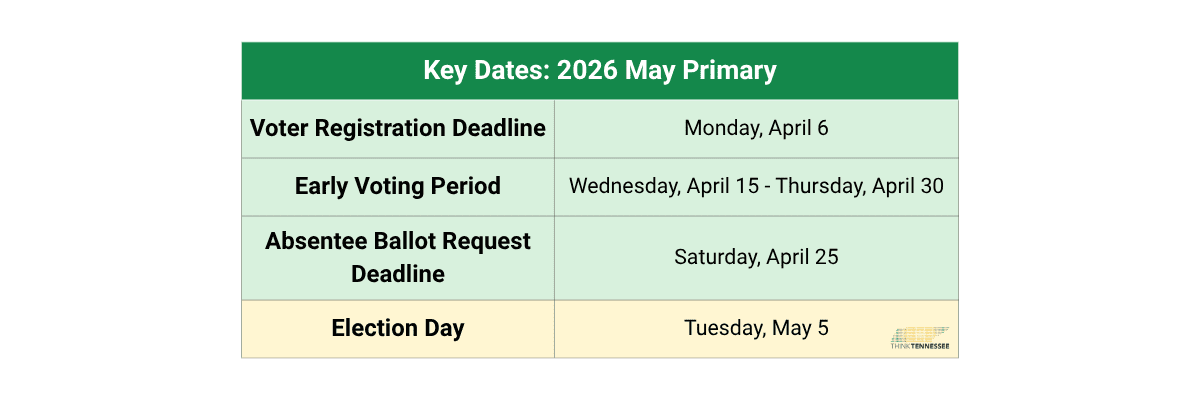
The election cycle for these local offices starts with the May 5th primary (if the county party calls for one – not all counties will have primaries for both parties) and ends with the August 6th general election (which is held at the same time as the primary races for the state and federal offices).
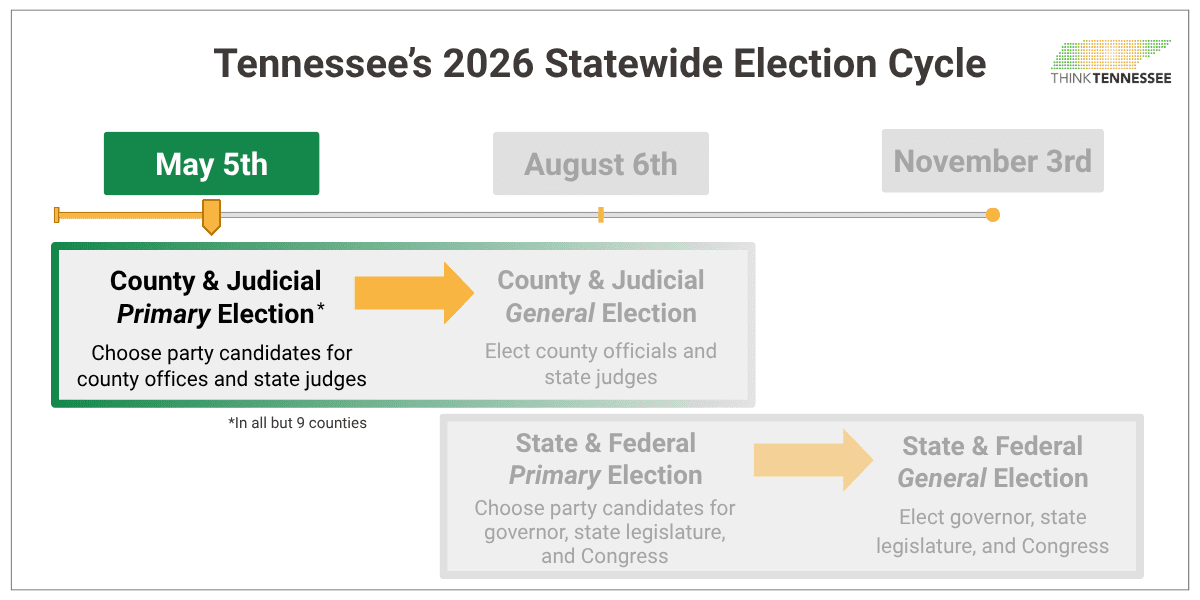
Historically, voter participation in county races – especially in the primaries – has been low. Yet these offices more directly shape Tennesseans’ daily lives and can have more tangible impacts than state and federal offices.
Today marks two weeks out from the voter registration deadline (April 6th) for the May primary elections. In preparation, below we share what the May elections are, what counties will be holding them, and what offices will be on the ballot – and the impact their roles have within our communities.
May primaries select party candidates to stand for election in August for county offices.
Primary elections select the party candidates who will run for offices on the general election ballot. Voters choose either the Republican or Democratic party ballot, and in doing so, they are affirming their allegiance to the party.
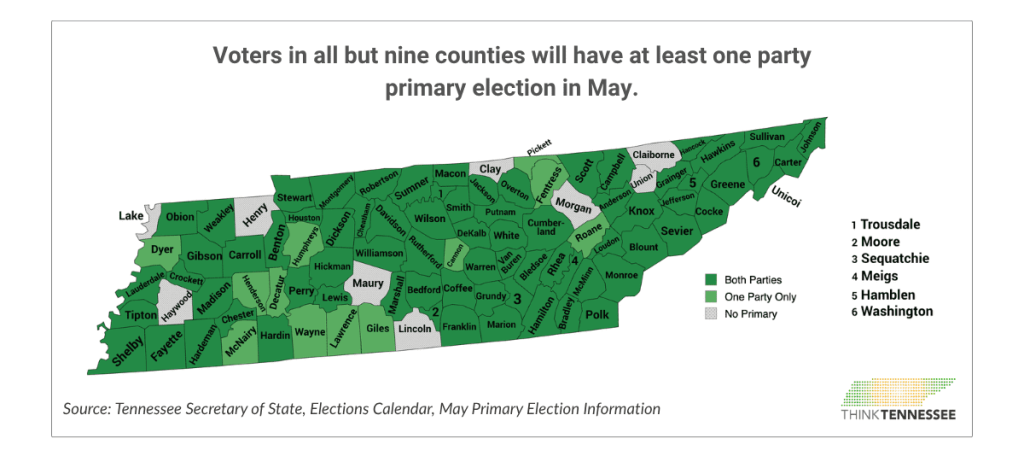
For local races, county parties can choose whether to call a primary election, and not every county or party does. This May, voters in all but nine counties will have a primary to participate in.
- 74 counties will hold both a Republican and Democratic primary,
- 11 counties will hold only a Republican primary, and
- 1 county will hold only a Democratic primary.
 Offices on the ballot in May can shape county leadership for years to come.
The decisions made by local elected leaders impact everyday life for Tennesseans. And while most county officials serve four-year terms and judges serve eight-year terms, that means choices made in May can have long-lasting impacts. For example:
- County mayors are the chief executives. They oversee tax and spending priorities and the management of departments such as sanitation and planning, influencing how effectively county government serves residents.
- County commissioners are the legislative body. They make the taxing and spending decisions that affect residents – from how much they pay in property taxes and how local dollars are distributed between schools, emergency services, and roads.
- Sheriffs oversee law enforcement in the county. They set the law enforcement priorities, run county jails, and make decisions that affect public safety.
- Trial court judges preside over cases dealing with criminal and civil issues, family matters, and financial disputes. Their decisions – how long someone is sentenced and whether someone is released on bail – impact the community and the local justice system, setting precedents for how issues will be handled in the future.
- School board members are the governing body for county schools. They make decisions about how schools operate and the curriculum taught that shape not only what students learn but also impact the community’s property values.
Yet participation in local elections – particularly May primaries – has been low.
Participation in primary elections typically trails general elections, and the same is true for these county offices. While voter turnout data is tracked at the state level for August and November, it is not for May elections. Looking at the data available at the county level for the last two similar May cycles, turnout has been below one in five registered voters. [i]
- May 2022: Participation of registered voters in the 23 counties where data was available averaged just 18.5% of registered voters.
- May 2018: Participation averaged 16.0% of registered voters in the 15 counties with accessible data.
The election year is just beginning.
While some municipalities and special elections are also on the calendar, May marks the first statewide election (for all but nine counties) of the 2026 cycle. The elections will determine which party candidates will run for office in August and how our counties will be governed for at least the next four years.
 This is the first in a series of blog posts we’ll share throughout this 2026 election cycle. Keep an eye out in our newsletter and LinkedIn for future posts leading up to the August and November elections.
Endnotes
[i] Pulled from reports of voter turnout from county election commission websites across the state, when available, and local news reporting from the May 1, 2018 and May 3, 2022 county primary elections.