

On November 3rd, Tennesseans join voters nationwide to cast ballots that will determine our federal congressional representation — all of Tennessee’s nine U.S. House seats and one of our two U.S. Senate seats are on the ballot. But that’s not all, we’ll also select our state-level representation: For the first time since 2018, we’ll elect a new governor to shape our state’s direction for at least the next four years, while also electing our state legislators — all 99 Tennessee House members and half of our 33 state senators — who, along with the governor, will determine the policies that affect Tennesseans every day.
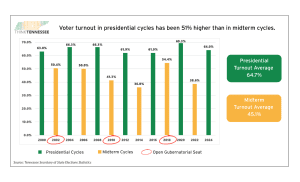
Historically, Tennessee midterm cycles have drawn fewer voters than presidential ones. So far this century, turnout in Tennessee in presidential cycles has averaged 64.7% while midterm cycle turnout has averaged 45.1%. Most recently, in the last four midterm and presidential election cycles, the difference has been even starker: presidential turnout has been 51% higher (at an average of 64.3%) than midterm turnout (an average of 42.6%). And our state consistently trails most other states in voter turnout — in the 2022 midterms, our turnout was the lowest in the country.
Will Tennesseans turn out in greater numbers this election cycle? We certainly hope so. November’s ballot offers a lot of opportunities to weigh in on decisions that will determine our state’s future, from our elected state and federal representatives to proposed amendments to our state constitution. Here’s a look at what turnout has historically looked like for similar races and what voters will find.
Tennessee hit our second-highest turnout mark in recent history in 2024’s presidential election — but midterm turnout is typically less than half that of presidential cycles.
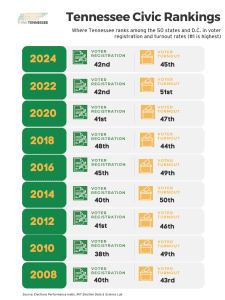
In 2024’s presidential election, Tennessee recorded our second-highest turnout (64.0%) since 2008’s 66.3%, behind only 2020’s record of 69.3%. Yet, compared to other states, that turnout ranked 45th lowest in the country — a consistent pattern for Tennessee in both presidential and midterm cycles. The state has ranked in the bottom 10 (mostly bottom five) among all 50 states and Washington, D.C. since at least 2008.
But even though turnout was high in the last election, that doesn’t mean that voter energy will translate into higher turnout this year. This is a midterm cycle, which typically sees less than half the turnout recorded in presidential cycles.
In Tennessee, we elect our governor in midterm cycles, and turnout differs depending on whether an incumbent is running or the seat is open. Open seats — like this year’s — typically draw higher turnout than races with an incumbent, though still less than presidential cycles. In the last comparable race, 2018, when Governor Lee was first elected, Tennessee saw the highest midterm turnout of registered voters so far this century.
Along with a new governor, voters will elect representatives for new congressional districts, choose at least 20 new representatives, and approve or reject three amendments to the state constitution.
Voters will be voting in new congressional districts this November.
Districts are typically redrawn only once a decade – after the U.S. Census updates population counts – and they stay in place until the next count shows how populations have shifted. But for the first time this year, after the U.S. Supreme Court weakened the Voting Rights Act’s anti-discrimination protections and eased the path to partisan gerrymandering, the governor called a special legislative session. Legislators redrew the congressional map just 10 weeks before the August primary — after the candidate-qualifying deadline had already passed. Legislators said their goal was a map that would elect all nine U.S. House members as Republicans.
While not apples to apples, in this past August’s primary elections, turnout was up in all congressional districts compared to the same numbered districts in the last midterm cycle (2022).
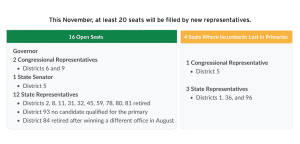
At least 20 seats will be filled by new representatives.
Going into the August primary, 15 seats were open as sitting members did not run for re-election: the governor’s seat, 12 state legislative seats (11 in the House and 1 in the Senate), and two U.S. House seats. After the primaries, at least five additional seats will be filled by new representatives as one U.S. House and three state House incumbents lost their primary races and an additional state representative (Representative Towns (D-Memphis)) retired after being elected as the Shelby County Criminal Court Clerk.
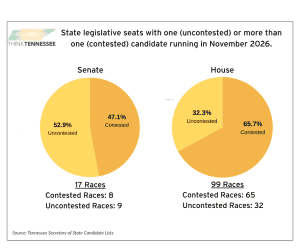
Most races are contested — voters will have more than one candidate to choose from.
The governor’s race and every congressional seat are contested by both major parties. At the state legislature, most House races (65.7%) are contested, just three fewer than in 2024’s election (when 68.7% of races were contested). This is reversing the trend of the previous two cycles where fewer than half of House races saw more than one candidate running. On the other hand, state Senate races are markedly less contested this year — just 47.1% have more than one candidate (8 with both major parties, 1 with one party and an independent), down from 58.8%–81.3% in recent cycles.
Three constitutional amendments
Amendments to Tennessee’s constitution must first pass the state legislature in two consecutive General Assemblies — a four-year process — before going to voters during a gubernatorial election. This year, Tennesseans will weigh in on three proposed amendments:
- Removing the Right to Bail for Certain Offenses. The constitution currently guarantees almost everyone the right to bail before trial, with an exception only for capital offenses (like first-degree murder) where the proof is evident. This amendment would let judges choose to also deny bail for specific additional offenses, including any of the more than 70 crimes that require serving at least 85% of a sentence.
- Prohibiting State Property Taxes. Tennessee doesn’t currently have a state property tax (they are levied locally). This amendment would add language to the constitution that bars the state legislature from levying, authorizing, or otherwise permitting a statewide property tax.
- Expanding Victims’ Rights (Marsy’s Law). Tennessee’s constitution already guarantees some victims’ rights; this amendment would add more, including the right to be heard in court proceedings and notified of key developments.
To pass, each amendment must meet two requirements:
- They must receive more “yes” than “no” votes, and
- The total of “yes” votes must exceed half of the total of votes for governor.
For example, if there were 1,068,760 votes cast for governor (as there were in August 2026), then the proposal would need to receive at least 534,381 “yes” votes and fewer “no” votes.
In the last few decades, nearly all constitutional amendment questions have been approved by Tennessee voters. Since 2002, just one out of 13 amendments has failed — and even that one received majority support, falling just short of the 50%-of-gubernatorial-vote threshold.
With so much at stake, will Tennesseans turn out and cast their votes to help determine our state’s future?
With just six weeks left until Election Day (November 3rd) we’ll soon find out what turnout looks like this cycle. With so much riding on this year’s races, we hope to see turnout exceed past expectations.
Would-be voters have two weeks until the voter registration deadline (October 5th) to get registered, update their registration with new addresses or names, or ensure that their registration information is correct. All of that can be done through county election commissions or through the secretary of state’s GoVoteTN website or app.
See you at the polls!