
Recent changes at the federal level—ranging from staffing reductions to funding cuts—are currently impacting Tennessee and will continue to impact the state for years to come. With a 10.2% reduction in Tennessee’s federal civilian workforce and significant changes to healthcare and food assistance programs, these federal changes are having a measurable impact on Tennessee families and communities.
In this blog post, we highlight what the available research tells us about how and where these federal changes are impacting Tennesseans.
Key Takeaways
- Federal Workforce: Federal executive actions reduced staff for services Tennesseans depend on daily by 10%.
- Healthcare Coverage: About 210,000 Tennesseans are expected to lose health insurance coverage by 2034.
- Food Assistance: New federal requirements place 374,000 Tennessee families at risk of losing SNAP benefits as federal law shifts program costs to states.
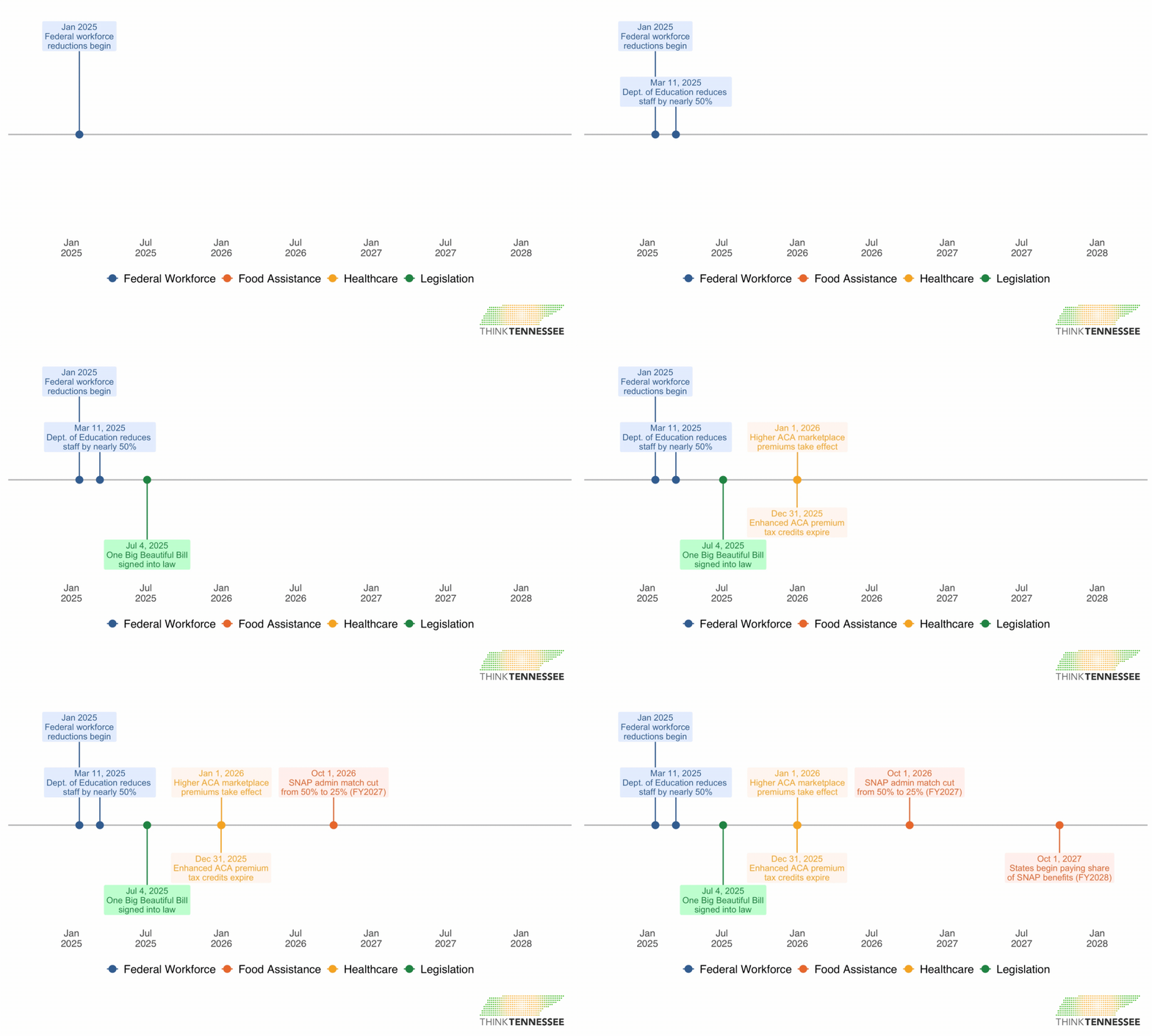
Timeline of Key Federal Policy Changes
Federal Workforce: Federal executive actions reduced staff for services Tennesseans depend on daily by 10%.
After a series of executive actions beginning in January 2025—including directing agencies to terminate probationary employees, cutting staffing at the Department of Education by nearly 50%, and cancelling approximately $400 million in AmeriCorps grants—the size of the federal civilian workforce was reduced. From December 2024 to December 2025, federal civilian employees declined 10.3% nationally.
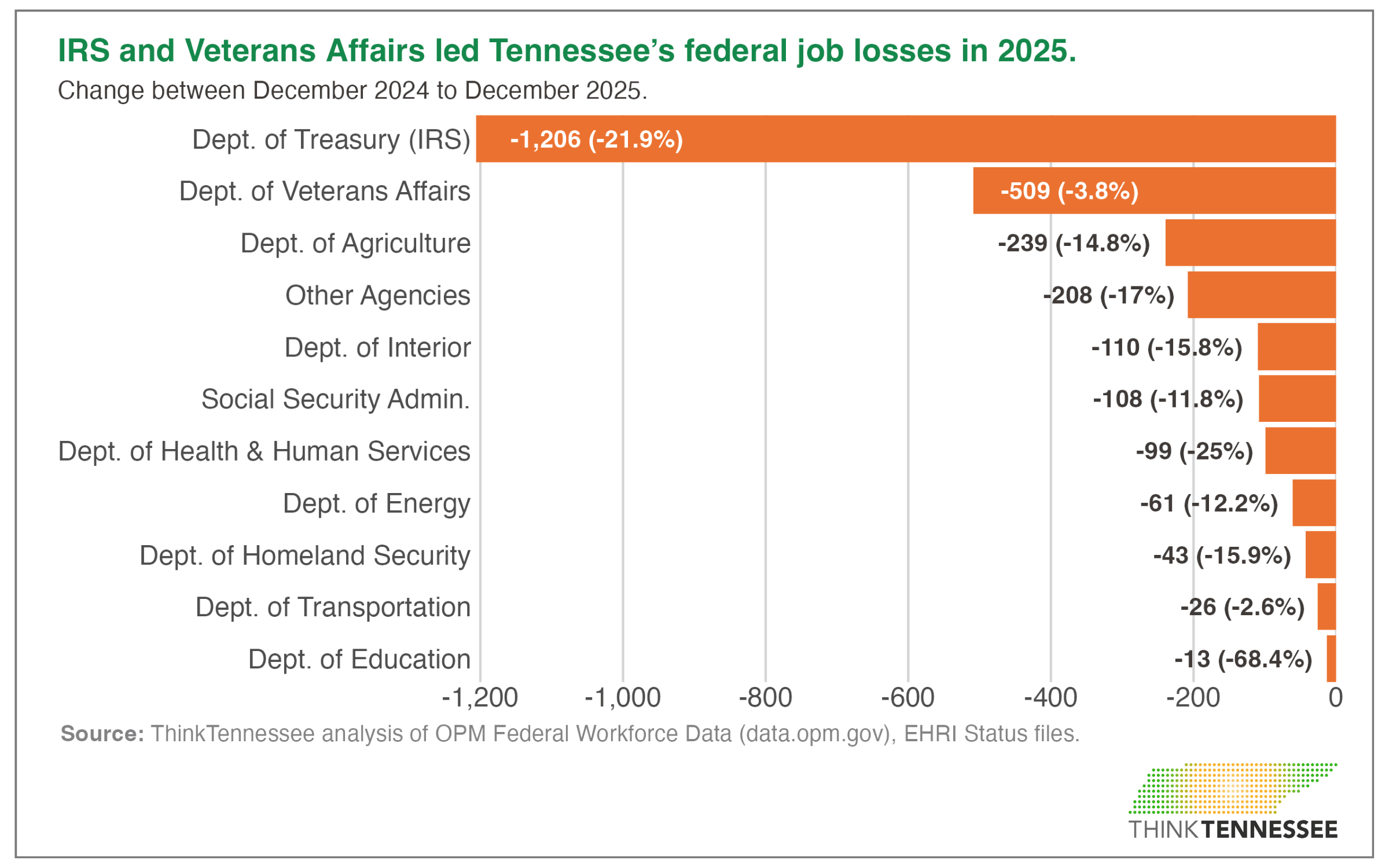
That decline was closely mirrored here in Tennessee as 2,622 federal employees lost their jobs over the same period—10.2% of the state’s 25,739 federal civilian employees.[1] The reductions touch nearly every area of federal service delivery that Tennesseans interact with daily, but two agencies saw the largest losses. The Department of Treasury (primarily the IRS) shed 1,206 positions, a decline of 21.9%, and the Department of Veterans Affairs shed 509 positions, a 3.8% decline in positions.
Healthcare Coverage: About 210,000 Tennesseans are expected to lose health insurance coverage by 2034.
More than 2 million Tennesseans depend on federal programs for health coverage: approximately 1.4 million through TennCare (Tennessee’s Medicaid program) and 642,867 through Affordable Care Act (ACA) Marketplace plans. Yet two overlapping policy changes are reducing federal support for these healthcare programs: new eligibility rules for TennCare and the expiration of enhanced ACA premium subsidies—temporary federal assistance that reduced monthly insurance premiums for ACA Marketplace enrollees.
TennCare eligibility restrictions and expiring ACA subsidies drive projected coverage losses.
The combined impact of TennCare eligibility changes—coming as part of a federal spending bill signed into law in July 2025—and the loss of ACA premium subsidies (which expired at the end of 2025 and have not yet been renewed by Congress)[2] could leave 210,000 Tennesseans without health insurance by 2034, according to the Kaiser Family Foundation (KFF).[3] Of this total, 24,000 would lose TennCare coverage primarily due to new federal eligibility restrictions and more frequent eligibility reviews.[4] Another 180,000 Tennesseans would lose ACA Marketplace coverage.
The 2034 horizon reflects the full cumulative impact, but for many Tennesseans, the disruption begins now.
The expiration of enhanced ACA premium subsidies took effect January 1, 2026, triggering an average premium increase of 32.6% for Tennessee Marketplace enrollees.[5] Of the 642,867 Tennesseans with ACA Marketplace plans in 2025, 611,247 (95%) received enhanced premium tax credits, meaning the premium shock is already landing on households this year.
The burden of these federal funding changes falls hardest on Tennesseans with the fewest alternatives: TennCare recipients near eligibility thresholds and Tennesseans purchasing insurance through the ACA Marketplace. A broader increase in the uninsured population is also likely to increase financial pressure on hospitals and healthcare providers, particularly those in rural communities, as uncompensated care costs rise.
Food Assistance: New federal requirements place 374,000 Tennessee families at risk of losing SNAP benefits as federal law shifts program costs to states.
The same federal spending bill signed in July 2025 also makes two significant changes to the Supplemental Nutrition Assistance Program (SNAP) that provides food assistance to families that will have direct consequences for the nearly 700,000 SNAP recipients[6] and the state budget.
An estimated 374,000 Tennessee families will lose some or all SNAP benefits as eligibility changes take effect.
New eligibility restrictions, including expanded work requirements applying to adults ages 18–64 without children under 14, up from the prior age range of 18–54, and noncitizen eligibility restrictions are already in place, meaning some Tennesseans have already lost benefits.
The 2025 federal spending bill also changes how benefit levels are calculated moving forward. Unlike previous regulations, which allowed USDA to periodically re-evaluate benefit levels above inflation when food costs or dietary standards warranted it, the 2025 federal spending bill limits future updates to inflation only. While this change does not reduce current benefits, it will limit the growth of food assistance for Tennessee families over time.
The Urban Institute estimates that 374,000 Tennessee families (53.4% of SNAP recipients in the state) will lose some or all of their SNAP benefits, with 84,000 families facing an average monthly reduction of $93.[7] Early enrollment data from the Tennessee Department of Human Services already shows that Tennessee’s SNAP participation dropped from 696,791 in July 2025 to 597,890 in May 2026—a loss of approximately 100,000 Tennesseans in less than a year.[8] And this is only the beginning, as the most significant eligibility and funding changes have yet to fully take effect. These changes affect a wide range of Tennesseans—from legal immigrants who have already lost eligibility, to working families, older adults, and the food banks and emergency providers that serve them.
Tennessee faces an estimated $354 million in new annual obligations as costs shift to states.
Two provisions of the law result in new fiscal obligations for Tennessee: a reduced federal share and a first-time requirement for states to contribute to SNAP benefits payments.
- Beginning in FY2027 (October 1, 2026), the federal share of SNAP administrative costs will drop from 50% to 25%, shifting that burden to states. Meaning that instead of covering 50% of the program’s administrative costs, Tennessee will now be responsible for 75%.
- Beginning in FY2028 (October 1, 2027), states will also be required to contribute toward SNAP benefit payments based on the state’s payment error rate—a federally audited measure of the share of benefits paid out incorrectly, whether too much or too little. Tennessee’s FY2024 error rate of 9.5% falls in the 8–10% tier, requiring the state to contribute 10% of benefit costs.
The combination of these two changes is estimated to result in a new annual state obligation of approximately $354 million, consisting of roughly $192 million in administrative expenses and $162 million in SNAP benefit cost share, based on data from the Sycamore Institute.[9] The state has begun to acknowledge but not yet fully address this new obligation. The FY2026-27 state budget reflects the administrative cost increase in the Department of Human Services budget but notes that the benefit cost-share “will occur in the fiscal year 2027-2028 budget and therefore is not considered in this budget”—meaning Tennessee’s larger SNAP obligation is still to come.[10]
Looking Ahead
Federal policy changes are taking effect across the workforce, healthcare, and food assistance sectors, creating a rolling series of impacts for Tennessee families, communities, and state government for years to come. The timeline of changes varies—while some are already affecting Tennesseans today, others will phase in over the coming years—but the cumulative picture points to significant adjustments ahead for both individuals and institutions.
This blog post is the first in a series of publications examining how federal funding changes are affecting Tennessee families, communities, and the organizations that serve them. Next, we’ll look at how these changes are affecting the state’s nonprofit sector, which plays a critical role in connecting Tennesseans to many of the programs and services discussed here.
Endnotes
[1] ThinkTennessee’s analysis is based on OPM EHRI Status monthly employment files downloaded from data.opm.gov on April 24, 2026. The data covers federal executive branch civilian employees with a duty station in Tennessee; it excludes U.S. Postal Service employees, most intelligence community employees, and legislative and judicial branch employees.
[2] The U.S. House passed a three-year extension of the enhanced premium tax credits in January 2026. As of publication, however, the Senate has not acted on the bill and the subsidies remain expired.
[3] To create this estimate, KFF allocated the Congressional Budget Office’s (CBO) national coverage-loss projections across states using Medicaid spending shares, 2025 ACA marketplace enrollment data from the Centers for Medicare and Medicaid Services, and 2023 American Community Survey data from the U.S. Census Bureau.
[4] More frequent eligibility reviews may cause eligible people to lose coverage due to paperwork and administrative delays.
[5] Calculation based on the average rate for the individual market in Tennessee in 2026 from https://ratereview.healthcare.gov/.
[6] Preliminary estimate from November 2025.
[7] Urban Institute modeled these estimates using the Senate-passed bill prior to enactment. Because the SNAP provisions in the enacted law were substantively unchanged from the Senate bill, Urban Institute’s authors consider these estimates applicable to the enacted law.
[8] In April 2026, Tennessee adopted expanded categorical eligibility for SNAP, raising the gross income limit from 130% to 200% of the federal poverty level and eliminating the asset test for qualifying households. The net impact on enrollment is not yet reflected in available data.
[9] The administrative estimate reflects 75% of Tennessee’s total SNAP administrative costs of $256 million annually per USDA data. The benefit-share estimate is based on Tennessee’s FY2024 payment error rate of 9.5%, which falls in the 8 to10% tier and triggers a 10% state match, producing an estimated $162 million obligation based on federal FY 2024 benefit levels per Sycamore Institute’s Table 2. Both figures are subject to change based on Tennessee’s error rate in future years.
[10] Tennessee FY2026-27 Budget Document, p. A-48.
Image source: Estes Kefauver Federal Building, Nashville, TN | Warren LeMay from Chicago, IL, United States, CC BY-SA 2.0 <https://creativecommons.org/licenses/by-sa/2.0>, via Wikimedia Commons