

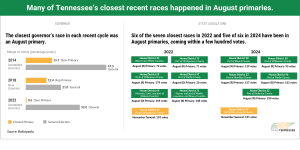
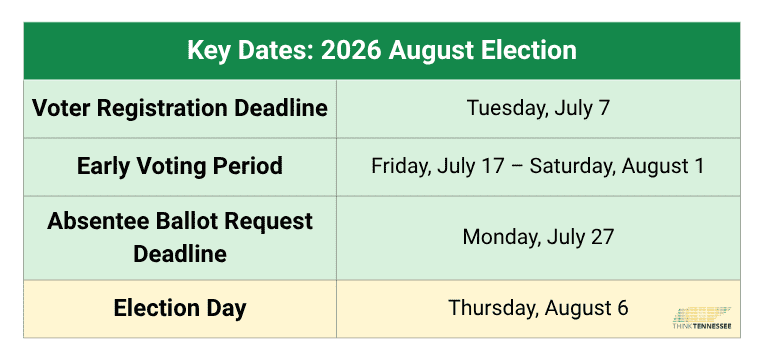
We are just two months away from the next Election Day of Tennessee’s 2026 statewide election cycle. On Thursday, August 6, voters will see both the Primary Election for state and federal offices that are on the ballot in November and the General Election for the county and judicial offices (whose Primary Election was held in May). Voters will select a party’s primary to participate in, and their ballot will have those candidates for state and federal offices, as well as the offices on the county and judicial general ballot.
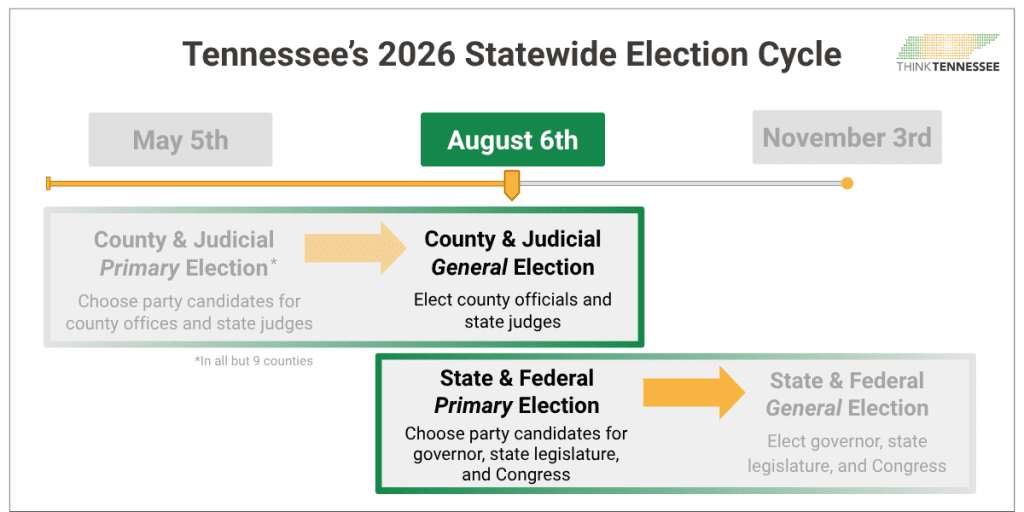
The August Primary Election is a big election for Tennesseans. This year, voters will see:
- An open governor’s race for the first time since 2018, as Governor Lee is term limited;
- Primary races that are likely to be more competitive than general election races; and
- Newly redrawn congressional districts, following a special session held late in the election calendar.
Primary races include Republican and Democratic candidates for an open governor’s seat.
This is a midterm election year, so the top office on the ticket is the governor (rather than the president). This year is the first open gubernatorial seat since 2018, and open governor’s races have historically seen higher voter turnout than those with an incumbent governor. For example, 2018’s open seat saw 54.5% voter turnout compared to just 38.6% in 2022, when Governor Lee ran for reelection.
Voters will also select party candidates for the state legislature and congressional races to run in November’s election.
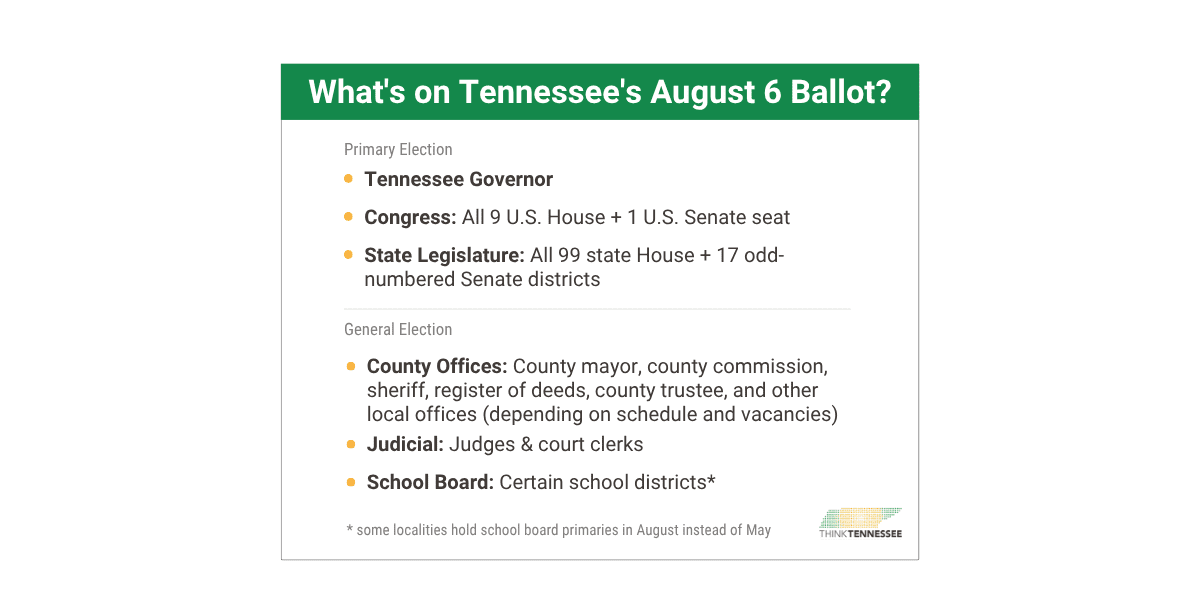 August primaries are when many of Tennessee’s closest and most competitive races happen.
August’s ballot will feature 127 state and federal offices. Because each office can have both a Democratic and Republican primary, there are 254 possible party primary contests. This year, more of the races are “competitive” in that they feature more than one candidate – 20.9% (53 out of 254 possible primaries) than the last two cycles, 2024 (19.6%) and 2022 (17.9%).
There are also more open state legislative seats where incumbents are not running for reelection – 12 in total (11 House and 1 Senate), up from just eight in 2024. In recent cycles, open seats have seen both more candidates competing and closer margins of victory than those where an incumbent is running.
Additionally, many of Tennessee’s closest statewide and legislative races have happened during August primaries – where candidates compete against members of the same party.
- Governor: In each of the last three gubernatorial elections, the closest contest happened in an August primary between candidates of the same party rather than a November general. From 2014 to 2022, the margin of victory ranged from 0.6 to 15.7 percentage points in August, compared to 21.0 to 47.5 percentage points in November.
- State Legislature: In the last two election cycles, contested August primaries were won by narrower margins than November general elections. In 2022, state legislative primaries were won by an average margin of 25 percentage points in August compared to 43 points in November. Similarly, in 2024, the average margin was 34 points in August compared to 44 points in November. In fact, only four November general elections in 2022 and six in 2024 came within 10 points (compared to 12 August primaries within 10-points in each of those years).
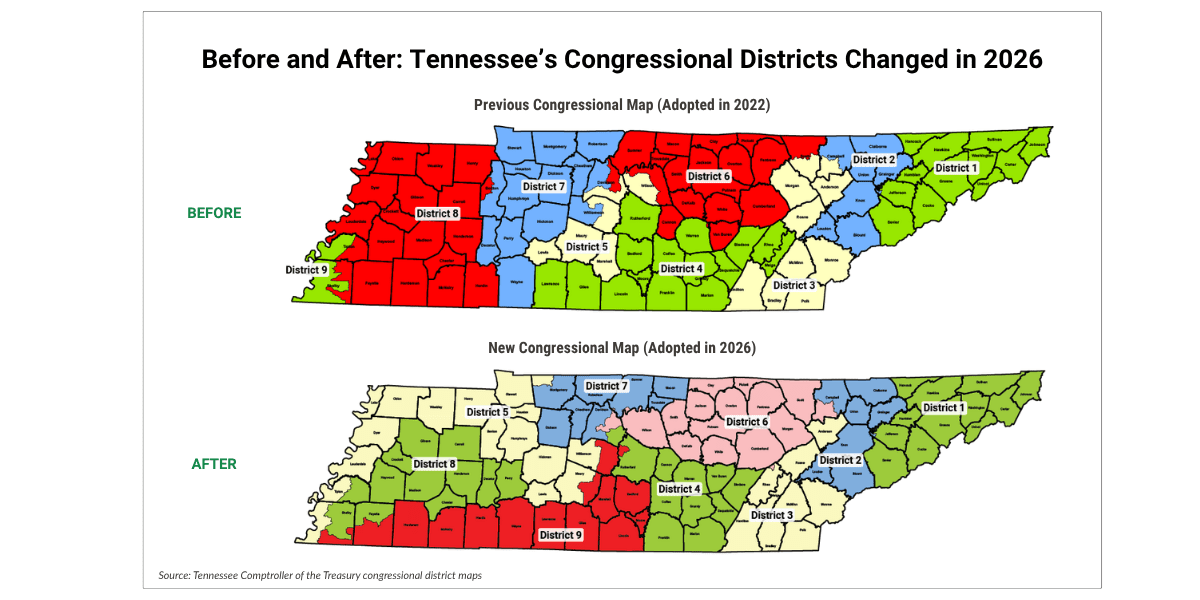
Last month’s redrawn congressional districts led to mid-election cycle changes for voters, candidates, and election officials.
In May, Governor Lee called the legislature into special session to redraw the state’s congressional districts – something that by law previously only occurred once a decade after the U.S. Census. Legislators stated that they were seeking to help Republicans maintain control of the U.S. House of Representatives by splitting Memphis into three (as opposed to two) districts and increasing Tennessee’s Republican delegation from eight to nine members.[1]
The updated maps reconfigured congressional districts across West and Middle Tennessee, impacting over 2.3 million active registered voters in 42 counties. The candidate filing deadline for these races had already passed (March 10), the first day to request absentee ballots for the election was the day after the new maps were signed into law (May 8), and Early Voting was 10 weeks away.
This kind of mid-cycle change is not typical – lawmakers generally choose to avoid big changes to election processes in election years to avoid voter confusion and allow election administrators time to carefully prepare for upcoming elections. This year, the candidate filing period was reopened (and conducted on a much-condensed timeline), candidates were given new districts and voters were given new candidates, and election officials have had to reassign impacted voters and adjust materials while also certifying the May 5 election results.
To complete the redistricting process, lawmakers amended a 1972 law that had prohibited mid-decade redistricting. Legislators also approved state funds to cover the estimated implementation cost of over $3 million, including about $1.9 million for new voter registration cards and another $1.25 million for overtime, election system modifications, and other election administration expenses.[2]
It remains to be seen how these late-cycle changes will impact voter participation.
What impact will these changes have on voter turnout? National rankings from the Elections Performance Index released last month for the 2024 presidential election show that voter turnout in Tennessee still trails most other states, coming in at 45th. While midterms typically see lower turnout than presidential cycles – 38.6% of registered voters in 2022 compared to 64.0% in 2024 – multiple factors (from the open governor’s race, more open legislative seats and contested races, and the attention of late changes to congressional races) all could have a unique impact on participation.
Tennesseans have two months before the next election – Thursday, August 6 – and one month before the voter registration deadline – Tuesday, July 7 – to become familiar with any changes to their districts and candidates and to ensure they’re registered and ready to cast their ballots.
Endnotes
[1] The special session followed the U.S. Supreme Court’s decision in Louisiana v. Callais, which limited how states may consider race when drawing congressional districts (including in efforts to create majority-Black districts under Section 2 of the Voting Rights Act). Legislatures may still consider partisanship when drawing maps.
[2] The Fiscal Review Committee of the Tennessee General Assembly estimates a $3 million financial impact of the new district maps.