

This blog post was written by Erin Hafkenschiel, president of ThinkTennessee.
 A couple weeks ago, I had the pleasure of joining the Nashville Area Chamber of Commerce’s Leadership Study Mission Trip to Miami.
Each year, the Nashville Chamber convenes civic, business, and nonprofit leaders to learn directly from peer cities. It’s a simple but powerful idea: If we want to solve complex challenges at home, we need to understand how other regions are approaching them. It is also a civic leadership best practice I’d love to see other Tennessee cities adopt.
Miami is a particularly relevant comparison for Nashville right now, despite being the center of a metro region that is three times larger. Like Nashville, it’s a fast-growing, nationally recognized city navigating questions about affordability, infrastructure, and long-term competitiveness.
The trip provided multiple lessons, but what stood out most wasn’t any single project, it was the intentionality behind how Miami is approaching its future.
The New Economic Map and Nashville’s Position
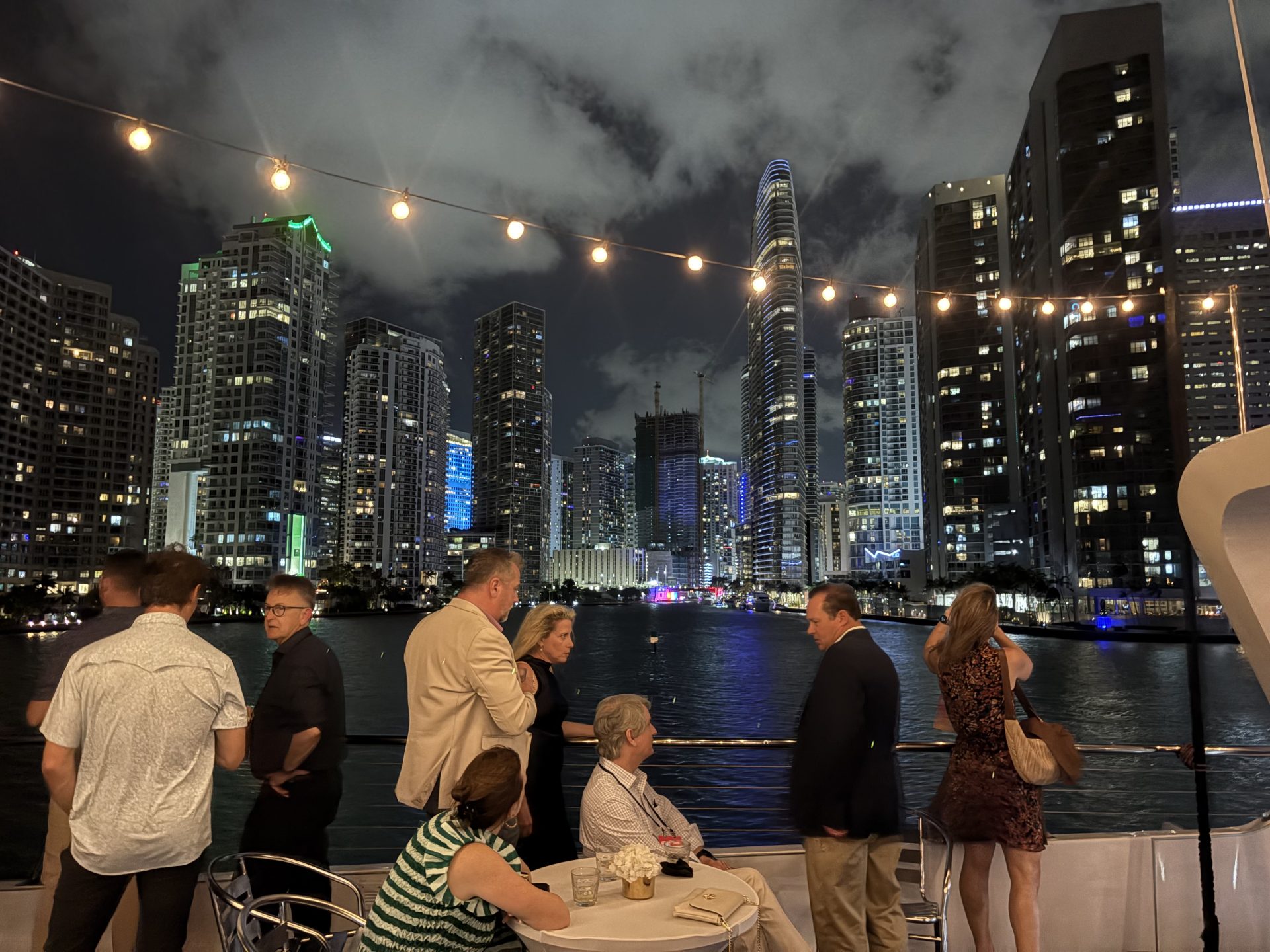
We kicked off the trip with a dinner cruise with renowned urbanist Richard Florida, who shared a preview of his forthcoming book The New Economic Map (and his recent article in the Financial Times). His framing of today’s economic geography was both simple and clarifying.
According to Florida, today’s economy is increasingly shaped by three types of cities: superstar cities, lifestyle (and tax) havens, and affordable middle markets. Cities like New York and San Francisco continue to attract young talent in finance and technology. Miami has positioned itself as a global destination for wealth, culture, and low taxes. And cities like Nashville and Dallas have emerged as more affordable hubs for the knowledge workforce and their families.
For Nashville, that framing reinforces something important: Our success has been driven by a combination of job growth in key clusters (healthcare, music, tech), a strong visitor economy (driven by our global “Music City” brand), and relative affordability compared to coastal markets. Those advantages are not guaranteed. If Nashville begins to lose ground on any of them, the region risks losing the very edge that has fueled its growth.
Successful Transit Requires Clarity of Purpose
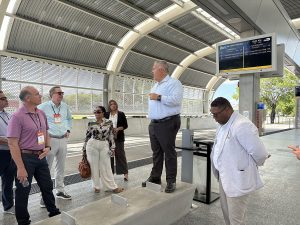 One of the most striking examples from Miami was the South Corridor Bus Rapid Transit (BRT) line. At 20 miles and $388 million, the project cost roughly $15–20 million per mile—an unusually cost-efficient price tag made possible by being able to utilize an existing dedicated right-of-way busway. But the real lesson was the focus on delivering high-quality transit, even at the risk of slightly diminishing service for single-occupancy vehicles (SOV).
Miami concentrated on a few key improvements:
- High-quality stations designed for faster, more comfortable boarding
- Traffic signal priority and intersection controls, such as gate arms, to reduce delays, and
- Use of an existing right-of-way, avoiding the need for costly land acquisition.
The result was significant: Travel times reduced by 30 minutes each way. The takeaway for Nashville isn’t that we can replicate this exact model, because we can’t. It’s that clear priorities and disciplined execution can deliver meaningful results.
Affordability as a Central Strategy for Long-Term Success
Across nearly every conversation, one issue surfaced again and again: affordability.
In a lunchtime chat with former Nashville Mayor Bill Purcell, Miami-Dade County Mayor Daniella Levine Cava described how her administration is approaching the issue of affordability. It is her defining priority.
Their approach includes a range of strategies:
- Enabling affordable housing on faith-based institutions: In 2025, the Florida State Legislature passed Senate Bill 1730, known as Florida’s “Yes in God’s Backyard” (YIGBY) law. This allows local governments the ability to approve affordable housing on land owned by religious institutions, even if that land is not zoned for residential use. It is estimated that this could unlock over 30,000 parcels statewide. Local governments opt into the program and set the development standards.
- Maximizing workforce housing (60% to 120% of area median income (AMI)) adjacent to transit: In July 2025, the City of Miami adopted new legislation establishing Transit Station Neighborhood Districts (TSNDs), which provide density bonuses and lower parking requirements for meeting specific affordability requirements. Uniquely, the city ordinance works in complement to the Florida’s Live Local Act (Senate Bill 102) and Miami-Dade County’s Rapid Transit Zones (RTZ), which require affordability on county-owned land and incentivizes it on private parcels within the RTZ boundaries.
- Financing tools to prevent homeowners from being displaced: Florida state law requires properties over 30 years old to undergo thorough structural and electrical inspections to ensure they meet updated safety requirements. These assessments, and resulting repairs, can be cost prohibitive for homeowners. Miami-Dade County created a program for homeowners to get up to $50,000 in zero-interest loans to pay for these repairs. Loans are available for homeowners earning less than 140% of AMI and living in high-impacted neighborhoods. Loan repayment is spread over 40 years with $50 monthly payments.
- Dedicated funding mechanisms to address homelessness: The Miami-Dade County Homeless Trust is funded by a 1% countywide food and beverage tax and raises about $40 million to $50 million annually. Enabled by state legislation approved in 1992, it became the first dedicated revenue to address homelessness in the country. About 85% of funds go towards preventing and ending homelessness (15% is allocated to domestic violence centers), including emergency shelters, permanent supportive housing, outreach and services, rental assistance, and prevention programs.
Across all of these strategies, what stood out the most was the consistency over many decades. Affordability isn’t treated as a side issue. It is embedded across policies and partnerships as a core pillar of long-term economic health.
Child Care as Economic Infrastructure
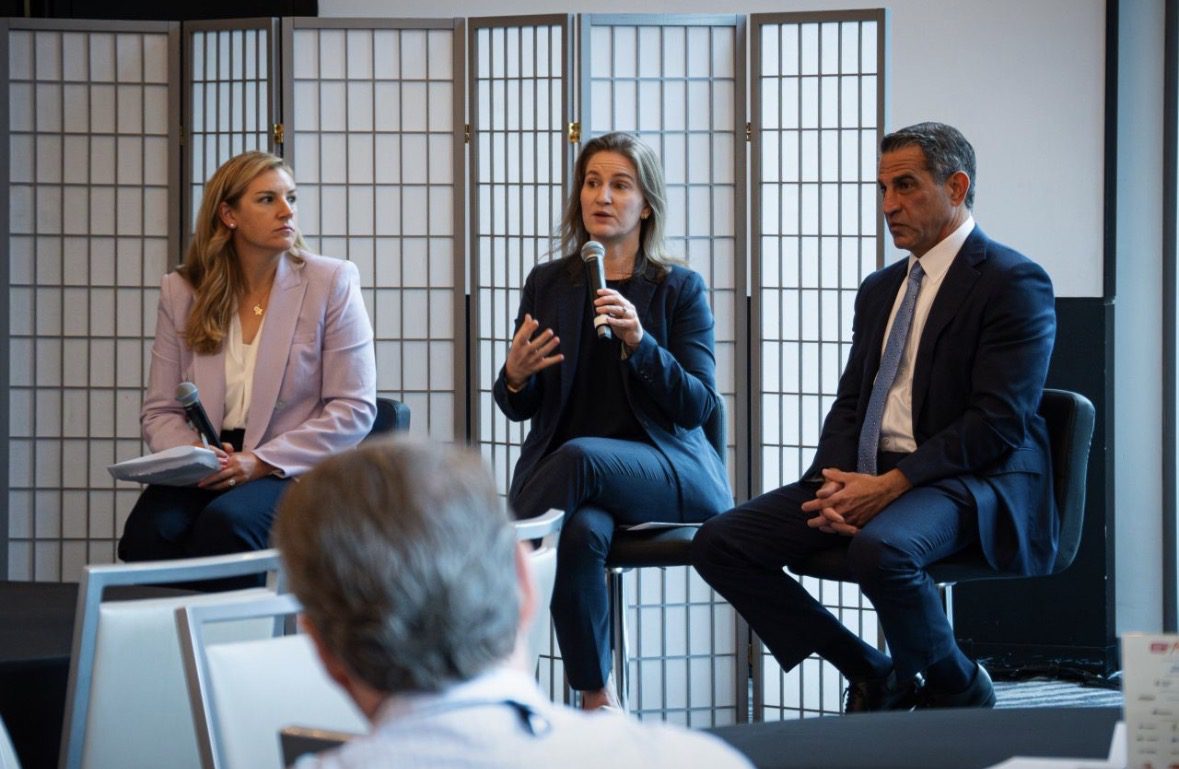 I had the opportunity to moderate a panel on child care with two exceptional leaders: Jim Haj of The Children’s Trust and Madeleine Thakur of The Children’s Movement of Florida.
Their work offers one of the clearest examples of how a region can align around a long-term investment. In 2002, Miami-Dade voters approved a dedicated property tax to fund children’s services. Today, that investment generates approximately $250 million annually and funds eight different programs: parenting, early childhood development, youth development, health and wellness, family and neighborhood supports, community engagement, learning and quality improvements, and special populations. One of the highlights is $60 million for child care scholarships for families at the fiscal cliff of federal and state benefits and tied to quality standards.
But the most important lesson wasn’t the funding structure. It was how the issue was framed. Early efforts failed when child care was positioned as a social service targeted at specific populations. Success came when it was reframed as a workforce and economic issue—one that affects businesses, all families, and the broader economy. That shift in framing, combined with strong business leadership and trusted messengers, helped build the coalition needed for long-term success.
The Partnership for Miami: Alignment at the Top
One of the most impressive models we saw was the Partnership for Miami, a CEO-led initiative focused on a clear long-term goal: A Miami for All.
The structure is intentionally tight: a small group of business leaders, a significant financial commitment, and a clear focus on education, transit, and affordability. Rather than trying to be all things to all people, the group has aligned around a shared vision for Miami’s future and uses data to track progress.
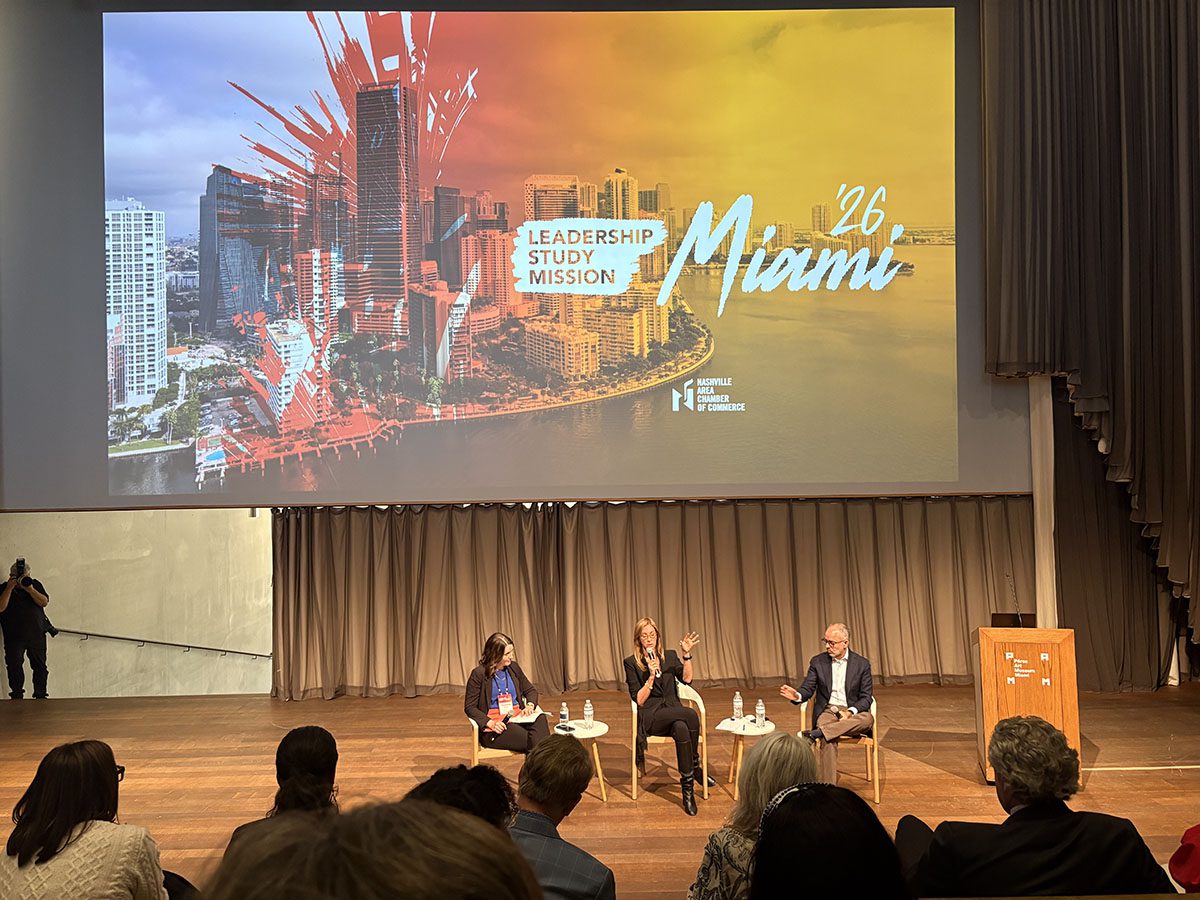
Their approach combines partnership and accountability. They work closely with elected officials, but they are also willing to speak candidly about challenges and advocate for change when needed. That balance — collaborative but ruthlessly focused — has helped build credibility and momentum.
The lesson for Nashville isn’t to replicate this exact model. It’s to recognize the power of alignment among top leaders and the importance of prioritization, grounded in data and sustained over time.
Defining the Future We Want
One idea surfaced repeatedly throughout the trip: You can’t assume the future will be good just because the present is.
Miami’s leaders are actively defining what they want their region to become and organizing around that vision. That requires a willingness to ask difficult questions, confront trade-offs, and stay focused on long-term outcomes.
In his closing remarks, Vanderbilt Chancellor Daniel Diermeier reflected on how this applies to Nashville. Like Miami, we are navigating challenges around transportation, housing, and homelessness. But we also have something distinctive: a strong sense of community and a globally recognized “Music City” brand.
“Our musicians are our beach,” he noted, which is a reminder that Nashville’s cultural assets are central to its identity and competitiveness.
What This Means for Nashville
Nashville is, in many ways, a “feel-good” city (a term multiple speakers used). People want to be here. They want to visit, live, and invest.
That’s a strength, but it’s not a strategy.
The real opportunity in front of Nashville is to build on that momentum with greater clarity and coordination. That means being honest about where the city is, aligning across sectors around shared priorities, and investing in the systems that will sustain Nashville’s growth over time.
The lesson from Miami isn’t about copying policies — though a few of them would be great to copy and paste. It’s about intentionality: defining the future Nashville wants and doing the hard work to make it a reality!